International edition · Relationship humour
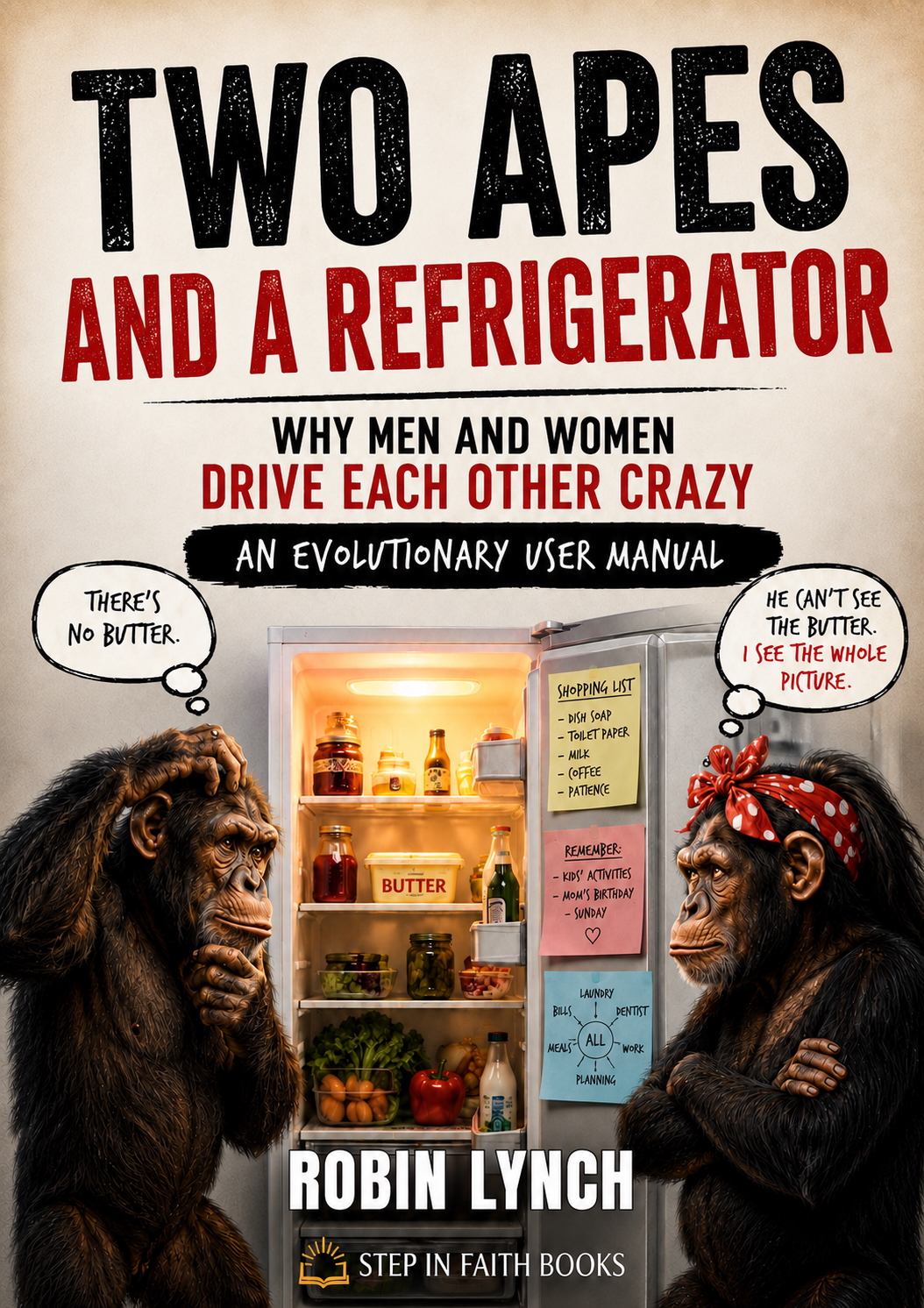
Two Apes and a Refrigerator
Why Men and Women Drive Each Other Crazy — An Evolutionary User Manual
Two people. One kitchen. Two completely different realities.
A funny evolutionary guide to relationships, communication and why the person you love can sometimes seem to live on another planet.
Available now on Amazon · Kindle & Paperback
If this sounds familiar…
- He can't find the butter. She can see everything else that needs doing.
- He offers a solution. She wanted thirty seconds of listening.
- Two people standing side by side, experiencing two completely different realities.
The big idea
Why can two people live in the same house, share the same life, and still experience completely different realities?
One of them opens the refrigerator and sees nothing. The other one walks past, sees the butter, the half-empty milk carton, the dishes, the kids' schedule and everything that has to happen before Friday.
Two Apes and a Refrigerator is a humorous field guide to the most optimistic project in human history: trying to understand each other. It looks at how we talk, how we hear something completely different, and how a question about butter turns into a full-scale relationship drama in nineteen seconds.
The book plays with the idea that our very modern relationships still run on very old software. The hunter meets the gatherer — except now they share a kitchen with Wi-Fi, a washing machine and a joint Google Calendar.
Communication differences
He solves the problem. She wanted to be heard. Both are convinced they were perfectly clear.
Everyday misunderstandings
Nobody is lying. Two brains simply ran two different searches and got two different results.
Relationship patterns
The same argument, in a new costume, every three weeks. Recognise it? Everyone does.
Evolutionary perspectives
A few hundred thousand years of survival instinct, now applied to a fridge shelf.
Available now on Amazon · Kindle & Paperback
Ready to meet the two apes?
Available now on Amazon · Kindle & Paperback
The film
One refrigerator. Two realities.
The smallest things create the biggest arguments.
Humour · Human behaviour · Evolution
Two people.One refrigerator.Millions of years of evolution.What could possibly go wrong?
Relationship humour, human behaviour and an evolutionary perspective in the same book: the laughter of recognition first, the explanation right behind it.
Available now on Amazon · Kindle & Paperback
Sound familiar?
The Butter Problem
He says
“I looked everywhere. There is no butter.”
She says
“It's literally right in front of you.”
This is not really about butter.
One brain is running a laser sight: lock on the target, delete everything else. The other one is running a 360-degree radar: register everything, all the time, including the things nobody asked about.
Neither one is broken. They are simply two different search algorithms sharing one refrigerator — and then wondering why the conversation went sideways.
He sees the butter.
She sees everything that is missing.
“I told you on Tuesday.”
“You said something on Tuesday. That is not the same thing.”
He offers a solution.
She wanted thirty seconds of listening.
“It's fine.”
It has never once been fine.
Two people standing side by side
living in two completely different realities.
One small thing.
One surprisingly large argument.
Available now on Amazon · Kindle & Paperback
Free sample
Not sure yet? Read a free sample.
The opening of Chapter 1 — no email required. Then decide.
Chapter 1
The Field of View and the Refrigerator
If archaeologists a thousand years from now are allowed to excavate only one scene from relationships in the 2020s, it should be this one. It unfolds in millions of homes every day, shortly before 6:30 in the evening.
The man is standing in front of a wide-open refrigerator. Cold white LED lights illuminate eight shelves, three door compartments, and two pullout produce drawers. He leans forward with his hands on his knees, his gaze stiffens, and he stares intensely into the void. After about five seconds of maximum cognitive effort, he announces with unshakable scientific authority:
“There is no butter.”
The woman walks into the kitchen. She does not need to stop; she does not even need to lean forward. She reaches her left hand behind a carton of milk and a half-empty jar of taco sauce, extracts the butter in approximately 0.8 seconds, and silently places it on the counter. Her expression is a perfectly balanced cocktail of resignation, subtle contempt, and quiet wonder at how this person ever managed to graduate from high school and obtain a driver's license.
The man remains in front of the open refrigerator, mildly offended and genuinely confused, and mutters faintly:
“But … it was actually behind the milk.”
What just unfolded in this kitchen was not carelessness. It was not proof that the man is mean, lazy, or suffering from acute vision loss. What we witnessed was the inevitable collision between two entirely different search algorithms, carved out over hundreds of thousands of years: the laser sight versus the 360-degree radar.
When a man opens the refrigerator door to find the butter, his brain does not launch a general survey of the contents. It initiates an ancient, hard-coded target-acquisition routine. The object must be in direct, unobstructed line of sight. Anything not a yellow or green rectangular object is instantly classified as visual noise and deleted from awareness. So when he says, ‘There is no butter,’ he is not lying. In his internal projected reality, the shelf is empty.
The woman's brain operates under an entirely different architecture. While he was trained for the linear pursuit of individual targets, she was trained in environmental scanning and resource mapping. She sees the whole ecosystem at once — including the butter an inch and a half behind the milk.
Two brains. One refrigerator. Zero shared understanding. And that is before anyone has even asked what is for dinner.
The downloadable PDF is on its way. Leave your email and we'll send it the moment it's ready.
Want the full chapter by email?
Inside the book
Two people. One refrigerator. Millions of years of evolution. What could possibly go wrong?
Humorous observations
Scenes you have absolutely lived through, described with the loving precision of someone who has clearly lost the same argument.
Relationship insights
Why small things escalate, why “nothing” is never nothing, and why being right is a terrible strategy.
Evolutionary perspectives
Playful, non-academic takes on where these instincts come from — and why they still show up in your kitchen.
Practical understanding
Not rules or homework. Just a better idea of what is actually happening on the other side of the conversation.
Maybe the problem isn't that we're bad at understanding each other. Maybe it's a small miracle that two apes ever managed to share a refrigerator at all.
Available now on Amazon · Kindle & Paperback
Early reader reactions
What readers keep coming back to
Humorous observations about everyday relationships
The nineteen-second escalation from a simple question to a full relationship summit.
An evolutionary perspective on modern love
Very old instincts, running inside a very modern kitchen with Wi-Fi and a shared calendar.
The refrigerator problem everyone recognises
Two brains, one shelf, and a piece of butter that only one of them can see.
Available now on Amazon · Kindle & Paperback
Get the book
Millions of years of evolution. We still can't find the butter.
A funny, surprisingly thoughtful guide to relationships and communication.
Available now on Amazon · Kindle & Paperback
Available now on Amazon · Published by Step In Faith Books
Two Apes and a Refrigerator
Kindle $4.99